
Blocking 101: Where People Stand = What They Feel (Filmmaking Guide)
Learn blocking in filmmaking with simple examples. Discover how actor positioning shows power, tension, intimacy, and emotion—without dialogue.
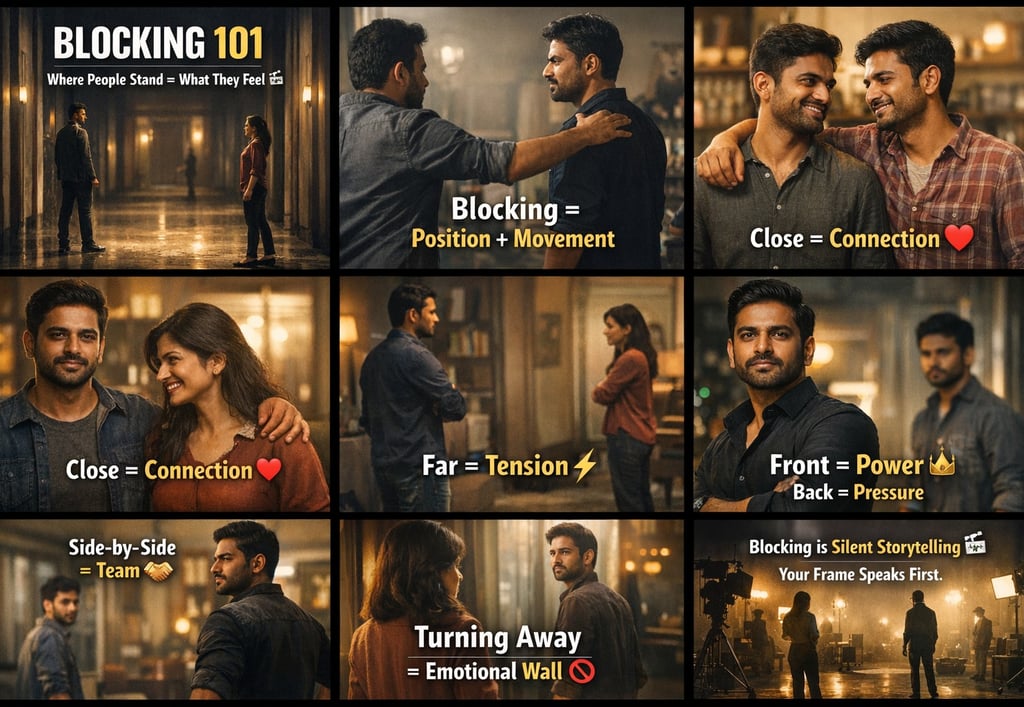
Blocking 101: Where People Stand = What They Feel (The Secret Language of Cinema)
If you want your videos to look cinematic, you don’t always need a bigger camera, a better lens, or fancy lighting.
Sometimes, you just need to answer one question:
Where should people stand?
That’s what blocking is.
Blocking is the invisible art that makes a scene feel:
intense
romantic
awkward
powerful
emotional
…without anyone saying a word.
In fact, in great cinema, the audience often understands the relationship dynamic before the dialogue even starts, because blocking already told them.
What Is Blocking in Filmmaking? (Simple Definition)
Blocking is the planned positioning and movement of people (actors/subjects) inside a scene.
It includes:
where the characters stand
how close they are to each other
who is closer to the camera
who moves first
who stays still
who enters or exits the frame
Blocking is not random.
It’s emotional choreography.
Why Blocking Matters More Than People Think
Blocking does three big things:
1) It shows relationships
Are two characters close? distant? hostile? connected?
2) It shows power
Who dominates the space? Who is shrinking?
3) It controls the audience’s attention
The eye naturally follows:
movement
proximity
the person closest to the camera
whoever occupies the “strongest” position in frame
So yes—blocking is also a tool to make shots look professional and intentional.
The Golden Rule of Blocking
Where people stand = what they feel.
Even if your subject isn’t acting, the audience will still “read” the scene emotionally based on spacing and positioning.
This is why blocking works in:
films
ads
brand videos
interviews
reels
documentaries
product videos
Blocking is storytelling everywhere.
7 Powerful Blocking Patterns (With Meaning)
1) Close Distance = Connection
When two people stand close, it communicates:
comfort
trust
romance
friendship
safety
Even without dialogue, closeness tells the viewer:
“These people are emotionally connected.”
📌 Use this when you want warmth and bonding.
Pro tip:
Keep them close and place them in the same side of the frame for maximum unity.
2) Far Distance = Tension
When people stand far apart, it communicates:
conflict
awkwardness
fear
emotional distance
mistrust
It tells the viewer:
“Something is off.”
📌 Use this when a scene needs discomfort or emotional separation.
Pro tip:
Add negative space between them to make the distance feel louder.
3) One Person in the Foreground = Dominance
If one character is closer to the camera, they feel:
more important
more powerful
more present
The person behind automatically feels:
smaller
less significant
pressured
Even if both are the same height, the foreground character wins visually.
📌 Use this to show hierarchy without saying it.
This is why in many “boss scenes,” the boss is foregrounded while others sit behind.
4) Higher Position = Authority
Blocking isn’t only left-right. It’s also up-down.
A person standing higher (stairs, stage, platform) communicates:
power
leadership
control
A person lower communicates:
weakness
fear
submission
📌 Use height differences when you want a power imbalance instantly.
Pro tip:
Combine height + low angle camera = extreme dominance.
5) Side-by-Side = Team Energy
When characters stand shoulder-to-shoulder facing the same direction, it communicates:
partnership
unity
“we’re together” energy
shared mission
It’s one of the simplest ways to show loyalty and connection.
📌 Use this in:
buddy moments
team wins
brand ads showing friendship
hero + mentor scenes
6) Back Turned / Face Away = Emotional Wall
When someone turns away, avoids eye contact, or keeps their back to another character, it communicates:
avoidance
guilt
shame
rejection
inner conflict
It’s a powerful way to show:
“They’re not ready to face the truth.”
📌 Use this for drama and emotional tension.
Pro tip:
Keep the “avoiding” character closer to frame edge to feel even more disconnected.
7) Blocking the Path = Control
When one character physically blocks another’s movement (standing in front of a door, standing between them and the exit), it communicates:
dominance
manipulation
control
intimidation
This is common in thrillers and confrontations because it’s primal:
“You can’t leave.”
Use it carefully—it’s a strong visual signal.
Blocking + Camera = Next-Level Storytelling
Blocking becomes 10x more powerful when paired with camera placement.
Example: Same Blocking, Different Feeling
Two people standing close can feel:
romantic → soft light + close-up
threatening → harsh shadows + tight framing
comforting → eye-level + warm tone
Blocking gives the foundation.
Camera decides the flavor.
Blocking Mistakes That Make Scenes Look Amateur
1) Everyone standing in a straight line
This feels staged, flat, and unnatural.
Fix: Stagger positions (foreground/background).
2) Too much empty space for no reason
Empty space should mean something (loneliness, tension, isolation).
Fix: Use space intentionally.
3) No movement at all
If blocking never changes, scenes feel static.
Fix: Add small motivation-based movement:
one step forward
turning away
sitting down
walking out
4) No hierarchy
If everyone looks equal in the frame, the scene loses direction.
Fix: Decide who leads the moment and block accordingly.
A Simple Blocking Formula (Works Every Time)
Before you shoot, ask:
Who has power in this moment?
Who wants control?
Who feels exposed?
Are they emotionally close or distant?
Who should the audience focus on first?
Your answers decide:
distance
height
foreground vs background
movement
That’s blocking.
Final Takeaway
Blocking is not “just where people stand.”
It’s how you show:
emotion
tension
dominance
love
distance
unity
…without explaining anything.
Where people stand = what they feel.
That’s the magic of visual storytelling.


Quick Links
Home
EPR Management
Copyright © 2026 Tinnu International Ltd. All Rights Reserved. Designed and maintained by Tinnu International Ltd.